Five Companies Own the Compute. A Few Hundred Million Idle GPUs Don't Care.
Open source models are having a real moment, and I believe it, because the numbers back it up. Alibaba's Qwen3.6, released this April, is fully open, Apache licensed, no waitlist, and the community-quantized versions built to run on consumer hardware have been downloaded over 700,000 times each. A subreddit built entirely around running large models on your own machine has grown to three quarters of a million members. The weights are genuinely free now, at a quality that would have been a frontier lab's flagship two years ago.
But a model is a file, and a file anyone can copy for free is not the same thing as AI anyone can actually use. You need a GPU with enough memory to hold the thing, and most people do not have one, did not budget for one, and are not about to buy one to try a chatbot. Open source solved the half of the problem that was always solvable: which models are open. It never touched the other half: who can run them. You can open source a model. You cannot open source a GPU, and that asymmetry, not the license on the weights, is the actual bottleneck on who gets cheap AI.
The concentration everyone names wrong
Most people, myself included until I looked closer, assume the AI divide is about which lab trained the best model. It mostly isn't. Epoch AI estimates that OpenAI's own compute use, for research, training, and inference combined, made up something like 10 to 15 percent of the world's operational AI compute at the end of last year. Add Anthropic, xAI, and the AI teams inside Google and Meta, and the frontier labs everyone argues about are still probably under half the world's total.
The five companies that actually hold the chips are Amazon, Google, Meta, Microsoft, and Oracle. As of the last quarter of 2025, those five own an estimated 71 percent of the world's cumulative AI compute, up from 63 percent two years earlier. Most of the labs training the models everyone debates, OpenAI included, are tenants. They lease the compute that decides what gets trained and what gets served, and the landlords are the same five names that already own most of the cloud.
You can open source a model. You cannot open source a GPU.
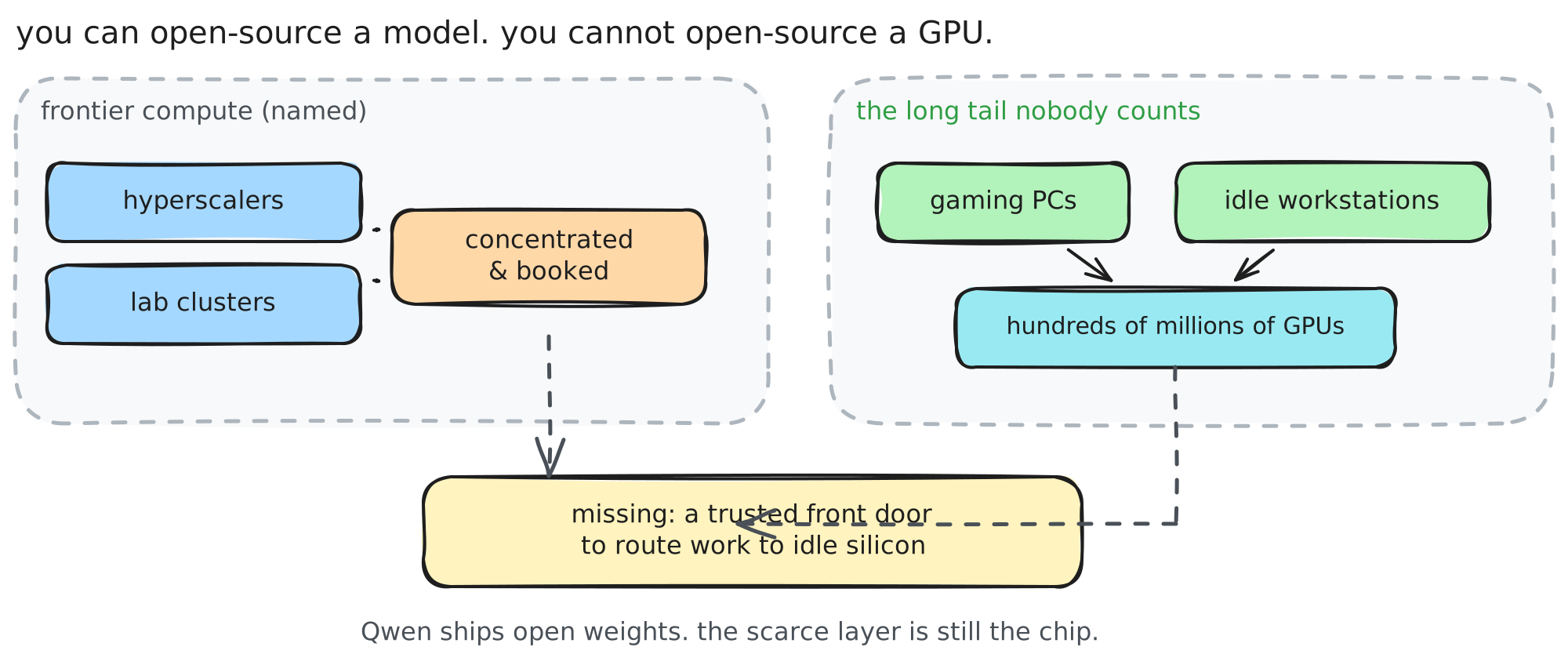
This is the part the "open source is winning" story skips. A model checkpoint costs nothing to copy. Upload it once and a million people download the identical weights at identical quality, forever, at zero marginal cost. A GPU does not work like that. It is a physical object, owned by exactly one entity at a time, that someone had to manufacture, ship, and plug in. You cannot torrent a GPU.
Run the math on what actually running an open model costs. Qwen3.6-27B, one of the strongest fully open models available right now, fits on a single high-end consumer card like an RTX 4090 at a workable quantization, producing roughly 30 to 40 tokens a second by community benchmarks. That is genuinely fast, genuinely capable, and genuinely accessible, to the fraction of people who already own a $1,600 GPU. Everyone else is exactly as locked out as they were before the model went open source. They just have a better reason to be annoyed about it.
There is more idle compute than anyone is counting
All those consumer GPUs are not hypothetical. Gamers, streamers, video editors, gaming cafes, offices, they own hardware that spends most of its life doing nothing more demanding than a browser tab. Akash Network's Homenode will tell you exactly what that idle time is worth: it estimates roughly $3,066 a year for a single RTX 5090 run at 50 percent utilization. That is one card. Multiply it by every gaming rig, streaming setup, and dozing office workstation on the planet, and the compute is not scarce. It is unpaid.
The pieces already exist. Nobody built the front door.
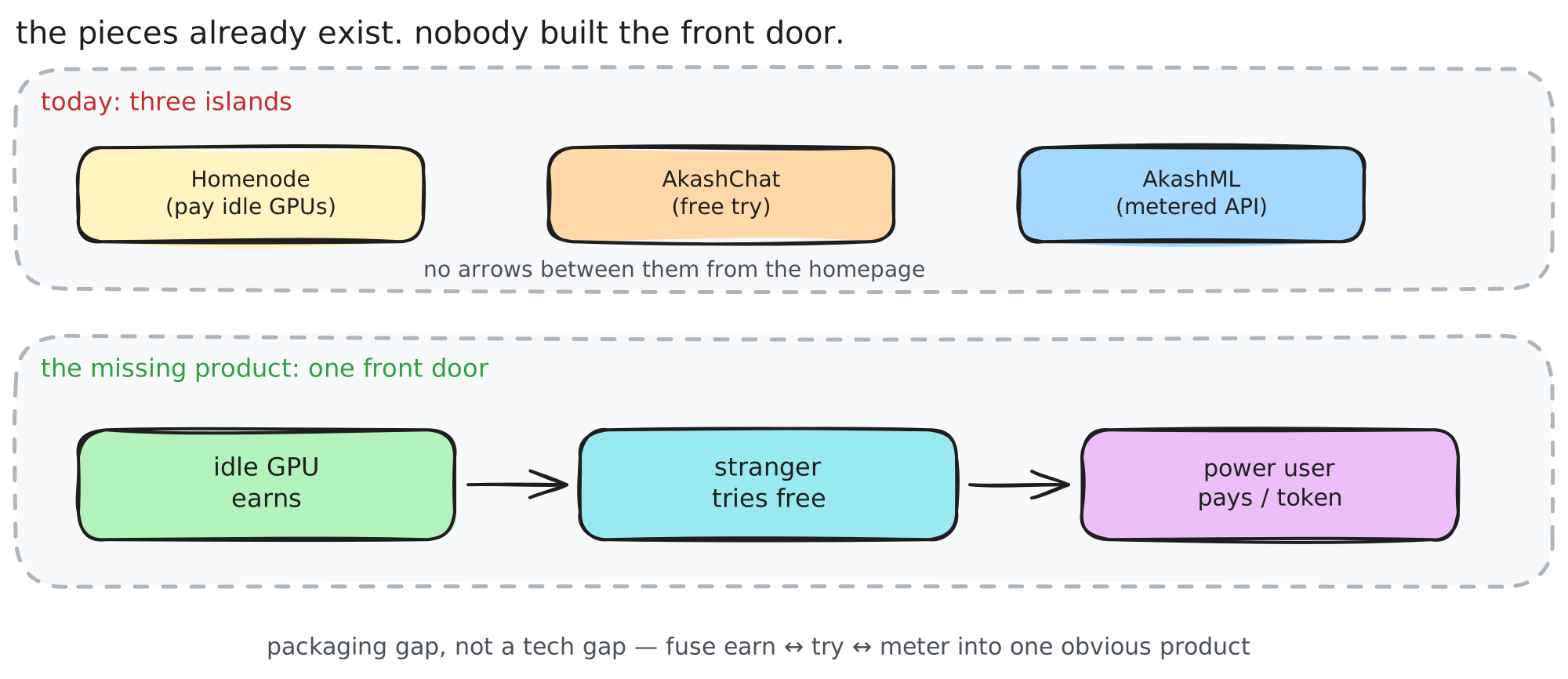
I want to be honest about something before I get to what I am building, because pretending nobody has done this would not survive five minutes of scrutiny and would not deserve to. Akash Network already ships almost exactly this idea. It just ships it as three separate products that do not appear to know about each other.
| Product | What it does | |---|---| | Homenode | Pays idle GPUs, gamers specifically, no server admin experience required | | AkashChat | Free, no-signup browser chat with open models: Llama, DeepSeek, Qwen, Mistral | | AkashML | Metered API, pay by the token, start immediately |
Pay idle consumer GPUs. Let a stranger try an open model for free. Charge per token once they want more. That is the idea in the brain dump that started this essay. Akash built it, in three pieces, none of which link to each other from Akash's own homepage, which reads like pure infrastructure copy, reverse auctions and container configs, nothing a normal person would click through to find a free chat page or a way to rent out their gaming PC. io.net's IO Intelligence gets close too, a free tier with 15-plus open models behind an OpenAI-compatible API, though it stays framed for developers with API keys rather than for someone who just wants to try a model.
So no, the mechanics are not new. What does not exist yet, as far as I can find, is one product that is obviously all three at once, with nothing to set up and nobody wondering which of three subdomains to visit. That packaging gap, not the underlying technology, is what I started building 48 hours ago.
48 hours, one gaming PC
The build so far is small on purpose. I got a Qwen model running for inference on my own gaming rig and served a test request through it. That is the entire proof of concept: one machine, one model, one request, answered by hardware that would otherwise have sat idle while I did something else. An API key still sits in front of it, that part is not going away, it is how access stays secure and metered. What goes away is the dev setup: no infrastructure to provision, no account with a cloud provider, no GPU to rent from a stranger's data center before you have even tried the model once.
The plan is the flip Akash has already proven works at the mechanics level: someone with a GPU earns money for hours they were not using anyway, someone who wants to try an open model pays a few cents instead of standing up a dev environment, and the difference between those two numbers is the business. Not a central company's margin on a rented data center. A person's margin on a card they already own.
The weights got free. The machine never will, and that's the business.
References: Epoch AI, "Frontier labs don't use most AI compute (yet)" (Josh You, May 2026); Epoch AI, "Five hyperscalers now own over two-thirds of global AI compute" (Emberson, You, Somala, April 2026); Qwen3.6-27B model card; Qwen3.6-27B-GGUF, unsloth; Akash Homenode; AkashChat; AkashML; io.net IO Intelligence.