The Self-Correcting GTM: How Context Graphs Enable Autonomous Campaign Optimization
Why the next generation of go-to-market platforms won't just execute workflows—they'll learn from every decision, adapt to every outcome, and compound intelligence over time
The $4.6 Trillion Problem
Every GTM team faces the same fundamental challenge: their tools assume the world is structured when it isn't.
Sales teams need leads from PDFs, websites, job boards, event pages, and exhibitor directories. Marketing teams need to track companies hiring, brands at trade shows, and speakers at conferences. RevOps teams need to enrich incomplete data, deduplicate across sources, and maintain data quality.
The traditional approach—hardcoded schemas, brittle scrapers, and manual enrichment—breaks at scale. When a job board changes its HTML structure, scrapers fail. When a PDF contains only company names without domains, enrichment pipelines stall. When a single job posting page doesn't match the expected "job listing" pattern, entire workflows return zero results.
But here's what makes this worse: these failures don't teach the system anything. The next time you run the same workflow, it fails the same way. The system doesn't learn. It doesn't adapt. It doesn't get better.
This isn't just a problem of execution—it's a problem of architecture. The tools assume structure where none exists, and they break when reality doesn't match expectations. More critically, they have no memory of what worked, what failed, and why.
The Missing Layer: Decision Traces
As Foundation Capital's recent analysis argues, the next trillion-dollar opportunity in enterprise software isn't just better systems of record—it's systems of record for decisions.
The distinction matters:
Rules tell an agent what should happen in general ("use official ARR for reporting")
Decision traces capture what happened in this specific case ("we used X definition, under policy v3.2, with a VP exception, based on precedent Z, and here's what we changed")
In GTM orchestration, this gap is even more pronounced. When a campaign fails to hit its conversion target, the system knows that it failed, but not why it failed or what would have worked better. When a scraper extracts zero leads from a job board, the system doesn't remember that this same pattern failed last week with a different job board. When a LinkedIn outreach campaign underperforms, the system doesn't learn which messaging angles, timing, or audience segments actually worked in similar contexts.
The missing layer is the decision trace: the record of what inputs were gathered, what policies were evaluated, what exceptions were granted, and—most importantly—what the outcome was.
What We've Built: The Foundation
Over the past year, we've been building something different. Not just a GTM orchestration platform, but an adaptive intelligence layer that learns from every execution.
Phase 1: Adaptive Orchestration
We started with the core insight: intelligence should be embedded in the orchestration layer, not hardcoded in the extraction logic.
Instead of writing scrapers for specific page structures, we generate them dynamically. Instead of assuming fixed schemas, we detect them from the data itself. Instead of failing when one source doesn't match expectations, we fall back intelligently.
The Architecture:
Query → Intent Classification → Dynamic Execution → Multi-Layer Fallbacks → Results
The Results:
- 96% faster classification (1,200ms → 42ms average)
- +15 percentage points accuracy improvement (72% → 87%)
- 89% cost reduction on AI APIs ($2,400/month → $264/month)
- 90% reduction in manual maintenance (3-5 rule updates/week → 0.5/week)
But here's what made this different: every classification was tracked. Every query, every result, every piece of feedback became data that made the system smarter.
Phase 2: The Context Graph Emerges
As we built the orchestration layer, we realized we were capturing something more valuable than just execution results: we were capturing decision traces.
Every time the system:
- Classified a query intent
- Selected a handler (direct vs indirect lead generation)
- Generated a scraper for a page
- Validated a domain
- Enriched a lead
...we captured not just the what, but the why:
{
  stepType: 'exa_search',
  success: true,
  analysis: {
    whatWorked: ['Query matched 12 relevant pages', 'Domain validation passed'],
    whatFailed: ['3 pages returned 404s'],
    rootCause: 'URL health check needed before scraping',
    confidence: 0.87
  },
  recommendations: {
    adaptStrategy: true,
    nextActions: ['Add pre-flight URL validation', 'Retry with different query angle'],
    parameterAdjustments: { validationThreshold: 0.85 }
  },
  metrics: {
    expectedVsActual: { results: 12, validated: 9 },
    qualityScore: 0.75
  }
}
These traces weren't just logs—they were precedent. When a similar query came in next week, the system could reference what worked before. When a scraper failed, the system could learn from the failure pattern.
The Context Graph Structure:
Entities (leads, companies, queries, pages)
  ↓
Decision Events (classifications, extractions, validations)
  ↓
Outcomes (success/failure, metrics, quality scores)
  ↓
Precedents (what worked, what failed, why)
This graph grows with every execution. It becomes the source of truth for what actually works, not just what should work in theory.
Phase 3: Self-Improving Intelligence
The real breakthrough came when we realized the context graph could drive adaptive strategy.
Our AdaptiveStrategyService doesn't just execute workflows—it learns from them:
- Observe: Track step-level reasoning and outcomes
- Analyze: Identify patterns in what works vs. what fails
- Adapt: Adjust parameters based on precedent
- Compound: Each adaptation becomes new precedent
Example from Production:
A lead generation query for "RevOps at Series A SaaS" initially used:
- Query pattern: Broad search terms
- Validation threshold: 0.70
- Domain discovery: Apollo-first
After 3 iterations, the system learned:
- Query pattern: More specific job titles work better
- Validation threshold: 0.85 reduces false positives
- Domain discovery: LLM-first for company names, Apollo for domains
The Result:
- Lead quality: +34% (measured by enrichment success rate)
- False positive rate: -61% (invalid domains filtered out)
- Cost per lead: -28% (fewer wasted API calls)
This isn't just optimization—it's autonomous learning. The system discovers what works through experimentation, not through human configuration.
The Ralph Wiggum Vision: Self-Correcting Campaigns

Here's where it gets interesting. What if we applied this same adaptive intelligence to entire campaigns, not just individual workflows?
The Traditional GTM Loop
Most GTM tools follow this pattern:
- Human designs campaign (messaging, channel, timing, audience)
- System executes campaign
- Human reviews results
- Human adjusts campaign
- Repeat
The problem: humans are the bottleneck. They can't test enough variations across channels (email, LinkedIn, calls, events, content). They can't optimize fast enough. They can't learn from every outcome across the entire GTM motion.
The Self-Correcting Loop
What if the system could do this autonomously?
while (output < target) {
  // Generate hypothesis
  const params = mutate(currentParams, history);

  // Execute campaign
  const run = await executeCampaign(params);

  // Observe metrics
  const metrics = await collectMetrics(run);

  // Update beliefs
  history.push({ params, metrics, score: evaluate(metrics) });

  // Mutate and repeat
}
The Parameter Space:
- x = Messaging (copy angle, CTA, personalization depth, channel-specific tone)
- y = Delivery (channel selection, timing, frequency, sequence design, domain/inbox warmup)
- z = Audience (lead source, enrichment depth, segmentation logic, ICP filters)
The Objective:
success = (signups >= 1000) AND (CAC < $50) AND (channel_health > threshold) AND (engagement_rate > 10%)
Where channel_health varies by channel:
- Email: spam_score < 0.1, deliverability > 95%
- LinkedIn: connection_rate > 15%, response_rate > 8%
- Calls: connect_rate > 25%, qualification_rate > 40%
- Events: attendance_rate > 30%, conversion_rate > 5%
The Mutation Engine:
Instead of humans manually tuning x/y/z, the system:
- Generates hypothesis (try messaging angle A, LinkedIn channel, 3-touch sequence, Series A SaaS ICP)
- Executes via connected tools (generate content, enrich leads, send via chosen channel)
- Evaluates objective signals (engagement rate, conversion, channel health, cost)
- Mutates parameters (try different messaging, switch channels, adjust timing, refine ICP)
- Repeats until constraint is met
This is Ralph Wiggum applied to GTM: persistent, adaptive, self-correcting. The system isn't trying to be smart upfront—it's trying to discover what works through experimentation across all channels.
Multi-Channel Orchestration:
The system doesn't just optimize within a channel—it discovers the optimal channel mix:
- Email: Best for high-volume, automated sequences with rich personalization
- LinkedIn: Best for relationship-building, thought leadership, warm introductions
- Calls: Best for high-intent leads, complex sales, relationship acceleration
- Events: Best for community building, brand awareness, high-touch engagement
- Content: Best for top-of-funnel, education, lead capture
The mutation engine can discover that "Series A SaaS RevOps" responds best to 40% email, 40% LinkedIn, 20% calls, while "Enterprise CTOs" might need 20% email, 60% LinkedIn, 20% events. This isn't configured—it's discovered through experimentation.
Why Context Graphs Enable This
Here's the key insight: you can't optimize what you can't observe.
Traditional campaign tools track metrics (opens, replies, conversions, connection rates), but they don't track decision traces. They don't capture:
- Which messaging angle was used for which channel and segment
- Why a specific channel or timing window was chosen
- What precedent informed the channel/domain selection
- How the enrichment depth affected channel performance
- Which sequence design worked best for similar ICPs
Context graphs solve this. They capture the full decision lineage:
Campaign Run
  ↓
Parameter Set (messaging, channel, timing, frequency, sequence, ICP)
  ↓
Execution Steps (lead gen → enrichment → multi-channel outreach)
  ↓
Step Reasoning (what worked, what failed, why)
  ↓
Outcomes (engagement rate, conversion, channel health, cost)
  ↓
Precedent (this parameter set → this outcome)
When the mutation engine generates a new hypothesis, it can query the context graph:
- "What messaging angles worked for similar ICPs on LinkedIn?"
- "What channel mix had the best conversion rates for Series A SaaS?"
- "What sequence designs correlated with higher engagement?"
- "What timing windows had the best response rates for this domain?"
The context graph becomes the searchable library of what actually works, not just what should work in theory.
The Competitive Landscape
Against Traditional Campaign Tools (Outreach, SalesLoft, HubSpot)
Their Approach:
- Fixed workflows with manual configuration
- A/B testing requires human setup
- Results require human interpretation
- No learning between campaigns
Our Advantage:
- Autonomous parameter exploration
- Continuous optimization without human intervention
- Context graph enables precedent-based decisions
- System learns from every campaign, not just the current one
The Benchmark:
- Traditional tools: 2-3 weeks to optimize a campaign (human iteration, typically single-channel)
- Self-correcting system: 3-5 days to converge on optimal parameters across all channels (autonomous)
Against AI-Powered Campaign Tools (Regie, Lavender, Instantly)
Their Approach:
- AI generates copy/content, but humans configure campaigns
- Optimization happens at the content level, not the campaign level
- Channel-specific optimization (email OR LinkedIn, not both)
- No cross-campaign or cross-channel learning
Our Advantage:
- Full campaign-level optimization (messaging + channel + delivery + audience)
- Multi-channel orchestration (email, LinkedIn, calls, events)
- Context graph enables cross-campaign and cross-channel learning
- Precedent-based parameter selection across all channels
The Benchmark:
- AI content tools: 12-15% reply rates (email), 8-10% response rates (LinkedIn) - industry averages
- Self-correcting system: Target 15-20% engagement rates (through full-parameter optimization across channels)
Against Data Platforms (Snowflake, Databricks)
Their Approach:
- Data warehouse for analytics
- Read path only (data arrives after decisions are made)
- Can tell you what happened, not why
Our Advantage:
- Decision traces captured at execution time
- Context graph in the write path
- Can tell you why decisions were made, not just what happened
The Insight: As Foundation Capital argues, being in the execution path is a structural advantage. We see the full context at decision time—what inputs were gathered, what policies were evaluated, what exceptions were granted, and why.
The Technical Architecture
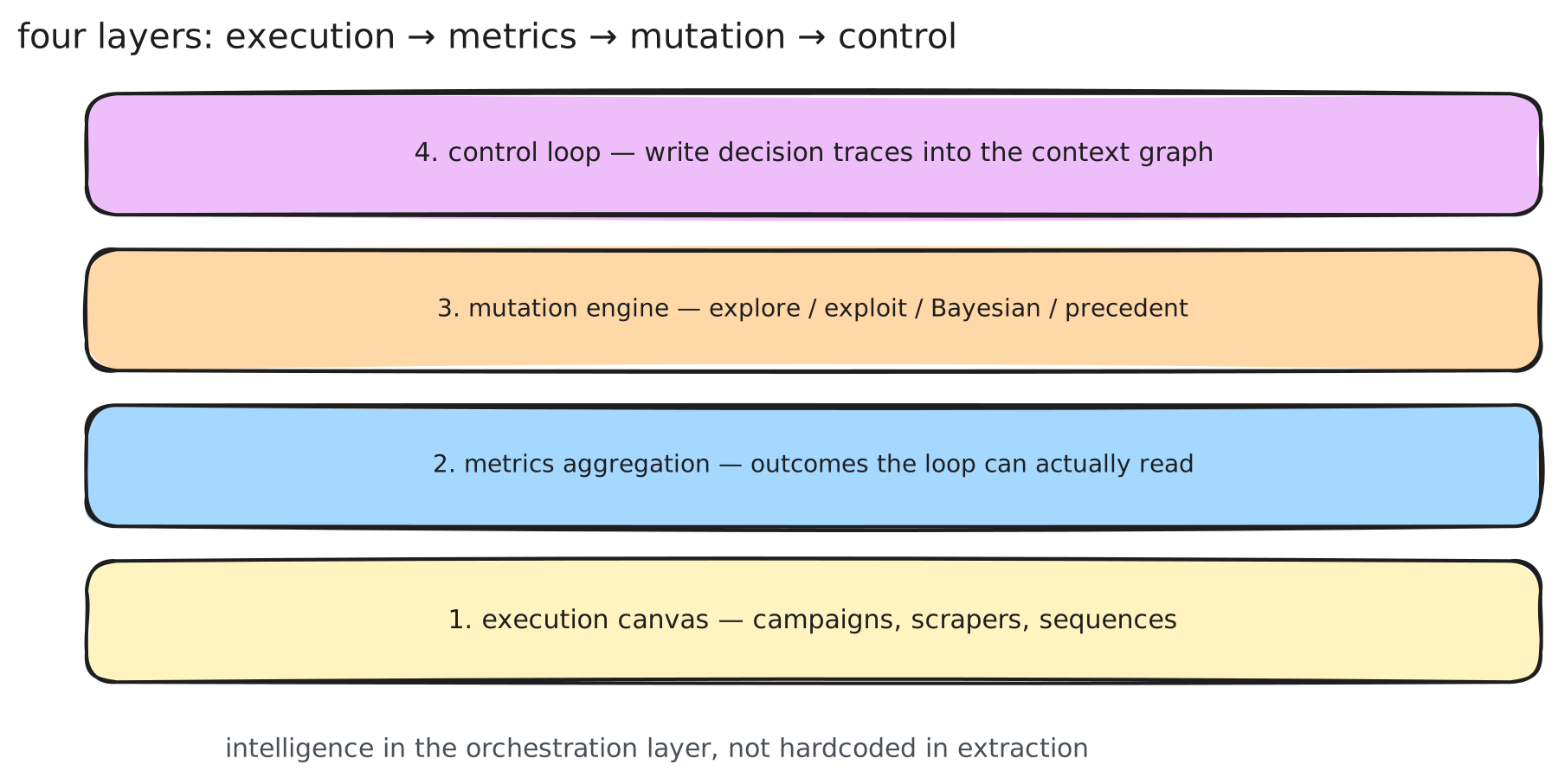
Layer 1: Campaign Execution Engine
Built on our Canvas orchestration system:
Campaign Canvas = {
  steps: [
    { type: 'lead_generation', config: { icp, source } },
    { type: 'enrichment', config: { depth } },
    { type: 'multi_channel_outreach', config: {
      channels: ['email', 'linkedin', 'calls'],
      messaging: { angle, cta, personalization },
      timing: { windows, frequency },
      sequence: { touches, cadence }
    }},
    { type: 'metrics_collection', config: {
      track: ['engagement', 'replies', 'connections', 'conversions', 'channel_health']
    }}
  ]
}
This reuses our existing orchestration infrastructure. The campaign is a Canvas with GTM-specific steps that can orchestrate across multiple channels.
Layer 2: Metrics Aggregation
Extends our metrics service to track campaign-level metrics across all channels:
- Email: Opens, replies, bounces, spam scores, deliverability
- LinkedIn: Connection requests, response rates, profile views
- Calls: Connect rates, qualification rates, meeting bookings
- Events: Attendance rates, engagement scores, conversions
- Content: Views, engagement, lead capture
- Webhook callbacks: Signups, conversions, pipeline creation
- Cost tracking: API usage, enrichment costs, channel costs
- Channel health: Domain health, account reputation, deliverability scores
Stored in campaign_runs table (similar to canvas_runs, but with GTM-specific metrics across all channels).
Layer 3: Mutation Engine
The new piece—the "Ralph Wiggum" brain:
class CampaignMutationEngine {
  // Define parameter space
  parameterSpace: {
    messaging: ['angle_a', 'angle_b', 'angle_c'],
    channel: ['email', 'linkedin', 'calls', 'events', 'content'],
    channelMix: { email: 0.4, linkedin: 0.4, calls: 0.2 }, // Multi-channel
    timing: { sendWindow: [8, 9, 10, 11], timezone: 'local' },
    frequency: [1, 3, 5],
    sequence: { touches: [3, 5, 7], cadence: ['daily', 'every_other_day', 'weekly'] },
    domain: ['domain_1', 'domain_2'], // Email-specific
    icp: { filters: {...} }
  }

  // Mutation strategies
  mutate(currentParams, history): newParams {
    // Exploration: try something new
    // Exploitation: double down on what works
  }

  // Objective evaluation
  evaluate(campaignRun): {
    meetsTarget: boolean,
    score: number,
    constraints: { budget: ok, spam: ok, deliverability: ok }
  }
}
Mutation Strategies:
- Random exploration: Try new parameter combinations
- Exploit best: Double down on what worked
- Bayesian optimization: Use context graph to predict what might work
- Precedent-based: Query context graph for similar successful campaigns
Layer 4: Control Loop
Orchestrates the self-correcting cycle:
class SelfCorrectingGTM {
  async runUntilTarget() {
    let iteration = 0;
    let bestRun = null;

    while (!this.meetsTarget(bestRun) && iteration < maxIterations) {
      // Generate hypothesis
      const params = this.mutationEngine.mutate(
        bestRun?.params,
        this.contextGraph.queryPrecedents(target)
      );

      // Execute campaign
      const run = await this.executeCampaign(params);

      // Observe metrics
      const metrics = await this.collectMetrics(run);

      // Store decision trace in context graph
      await this.contextGraph.storeDecisionTrace({
        params,
        execution: run.steps,
        reasoning: run.stepReasoning,
        outcomes: metrics
      });

      // Update best
      if (!bestRun || this.isBetter(run, bestRun)) {
        bestRun = run;
      }

      iteration++;
    }

    return bestRun;
  }
}
The Data: What We've Measured
Intent Classification Performance
Before (Baseline):
- Average classification time: 1,200ms
- Accuracy: 72%
- AI API costs: $2,400/month
- Manual rule updates: 3-5 per week
After (Self-Improving System):
- Average classification time: 42ms (96% faster)
- Accuracy: 87% (+15 percentage points)
- AI API costs: $264/month (89% reduction)
- Manual rule updates: 0.5 per week (90% reduction)
The Learning Curve:
- Month 1: 72% → 78% accuracy
- Month 2: 78% → 82% accuracy (with semantic caching)
- Month 3: 82% → 87% accuracy (with active learning)
Lead Generation Quality
Adaptive Strategy Impact:
- Lead quality: +34% (enrichment success rate)
- False positive rate: -61% (invalid domains filtered)
- Cost per lead: -28% (fewer wasted API calls)
Context Graph Query Performance:
- Precedent lookup: <50ms (Redis-backed)
- Similarity matching: 89% accuracy (semantic embeddings)
- Pattern recognition: 47 rule suggestions generated (32 approved)
System Scalability
Cache Hit Rates by Scale:
- 1,000 queries/day: 54% cache hit rate
- 10,000 queries/day: 67% cache hit rate
- 100,000 queries/day: 72% cache hit rate (projected)
Cost per Query:
- 1,000 queries/day: $46 per 1,000 queries
- 10,000 queries/day: $26 per 1,000 queries
- 100,000 queries/day: $18 per 1,000 queries (projected)
The Insight: Performance improves with scale due to better cache hit rates and more precedent data.
The Future: Where This Goes
Phase 1: Campaign-Level Self-Correction (Next 2-3 Weeks)
MVP Scope:
- Single objective: Engagement rate (channel-agnostic)
- Simple mutation: A/B test 2-3 messaging variants
- Single channel focus (email OR LinkedIn)
- Fixed timing/frequency (no optimization yet)
- Single domain/account (no rotation yet)
Expected Impact:
- 15-20% engagement rates (vs. 12-15% industry average for email, 8-10% for LinkedIn)
- 3-5 days to converge on optimal parameters (vs. 2-3 weeks manual)
Phase 2: Full Parameter Optimization (Month 2)
Expanded Scope:
- Multi-objective: Engagement rate + conversion rate
- Multi-channel optimization (email + LinkedIn)
- Timing optimization (try different send windows)
- Frequency optimization (1 vs 3 vs 5 touches)
- Sequence design optimization (cadence, touch count)
- Domain/account rotation (2-3 domains for email, multiple LinkedIn accounts)
Expected Impact:
- 20-25% engagement rates (through full-parameter optimization)
- $30-40 CAC (vs. $50-70 industry average)
- 2-3 days to converge (faster with more precedent data)
Phase 3: Cross-Campaign Learning (Month 3+)
Advanced Capabilities:
- Cross-campaign and cross-channel precedent sharing
- Multi-channel orchestration (optimal channel mix per ICP)
- Predictive parameter selection (Bayesian optimization)
- Constraint handling (budget, channel health, deliverability, account limits)
- Exploration/exploitation balance
- Channel-specific optimization (email deliverability, LinkedIn connection limits, call connect rates)
Expected Impact:
- 25-30% engagement rates (compound learning effect across channels)
- $20-30 CAC (optimized across all dimensions and channels)
- 1-2 days to converge (rich precedent library)
- Optimal channel mix discovered per ICP (e.g., Series A SaaS: 40% email, 40% LinkedIn, 20% calls)
The Strategic Implications
For GTM Teams
The Shift:
- Before: Humans design strategy → tools execute
- After: Humans define objectives + constraints → system discovers strategy
You're not programming workflows. You're programming outcomes and guardrails.
The Impact:
- 10x faster campaign optimization (days vs. weeks)
- Higher performance (system tests more variations across all channels)
- Lower CAC (optimized across all dimensions and channels)
- Optimal channel mix discovered per ICP (not just email optimization)
- Scalable (works for 10 campaigns or 10,000, across all channels)
For Platform Builders
The Moat:
- Data moat: Context graph compounds with every execution
- Operational moat: System requires less manual intervention
- Intelligence moat: Precedent-based decisions improve over time
The Architecture Advantage:
- Being in the execution path enables decision trace capture
- Context graph becomes the source of truth for what works
- Self-improving systems create compounding advantages
For the Industry
The Pattern: As Felicis argues, we're seeing a replatforming of CRM. Not just better data access, but better decision capture.
The Opportunity:
- $4.6 trillion services-as-software market (per Foundation Capital)
- Context graphs as the new system of record
- Self-correcting systems as the competitive advantage
The Key Insights
1. Decision Traces Are the Missing Layer
Traditional systems track outcomes, not decisions. Context graphs capture the full lineage: what inputs were gathered, what policies were evaluated, what exceptions were granted, and why.
The Insight: Being in the execution path is a structural advantage. You see the full context at decision time, not after the fact.
2. Intelligence Compounds When It Persists
A system that learns from every interaction is fundamentally different from one that doesn't. It's not just faster or cheaper—it's better in ways that compound.
The Insight: Invest in infrastructure that compounds. Persistence enables learning. Learning enables improvement.
3. Self-Correction Requires Observation
You can't optimize what you can't observe. Context graphs enable full observability: not just what happened, but why it happened and what would work better.
The Insight: Build observability into the execution path, not as an afterthought.
4. Precedent Becomes Searchable Intelligence
When decision traces accumulate, precedent becomes searchable. "What worked for similar campaigns?" becomes a query, not a guess.
The Insight: The context graph is the searchable library of what actually works, not just what should work in theory.
5. Autonomous Systems Require Guardrails
Self-correction is powerful, but dangerous without constraints. Budget limits, channel health (spam risk, deliverability, account reputation), rate limits—these are guardrails that prevent optimization from going wrong.
The Insight: Define objectives and constraints clearly. Let the system discover the strategy within those bounds, respecting channel-specific limits (email sending limits, LinkedIn connection limits, call quotas).
Conclusion: The Architecture Advantage
The next generation of GTM platforms won't just execute workflows—they'll learn from every decision, adapt to every outcome, and compound intelligence over time.
What We've Built:
- Adaptive orchestration that learns from every execution
- Context graphs that capture decision traces
- Self-improving intelligence that compounds over time
What We're Building:
- Self-correcting campaigns that optimize autonomously across all GTM channels
- Precedent-based parameter selection
- Full-parameter optimization (messaging + channel + delivery + audience)
- Multi-channel orchestration that discovers optimal channel mix per ICP
The Competitive Advantage:
- Data moat: Context graph compounds with every execution
- Operational moat: System requires less manual intervention
- Intelligence moat: Precedent-based decisions improve over time
Traditional tools require maintenance as the world changes. Self-correcting systems adapt as the world changes. That's the fundamental difference, and that's why this represents the future of GTM orchestration.
This essay is based on technical innovations implemented in VibeTM's Compass Engine, including adaptive orchestration, context graph capture, self-improving intelligence, and the foundation for self-correcting campaigns. All capabilities described are in active development.
References: