Acquired Taste
The defining claim of the AI era is that anyone can now build anything. Describe an app and a model writes it. Describe a campaign and it ships. The barrier to making things has fallen further and faster than almost any barrier in recent economic history.
I think the claim is true. I also think it is far less valuable than it sounds, and the reason is worth sitting with, because it quietly changes what is actually worth getting good at.
Making got cheap, and the data backs it up
By 2026, 84% of developers say they use or plan to use AI coding tools, up from 76% a year earlier, and about half use them every day. Building software now looks a lot like what Andrej Karpathy named "vibe coding": "you fully give in to the vibes, embrace exponentials, and forget that the code even exists." The barrier to producing a working app has effectively collapsed.
Worth noting the asterisk most headlines skip: trust is moving the other way. In the same survey, only 29% of developers say they trust the accuracy of AI output, down from 40% the year before, and more now actively distrust it (46%) than trust it (33%). Capability went up. Confidence went down.
So did the flood
When making gets cheap, you get more of it. The App Store and Google Play each host roughly 2.3 million apps, with well over a thousand new ones added every day. On the open web, a Graphite analysis of 65,000 pages found AI-written articles passed human-written ones in late 2024 and have hovered near half of new content since.
The flood is real but uneven, and that nuance is the whole point. The same researchers note that AI-written pages are far less visible in search than their share of publishing suggests. Volume and visibility are not the same thing. Making a lot is easy. Making something that gets seen and used is not.
Abundance is just a price cut
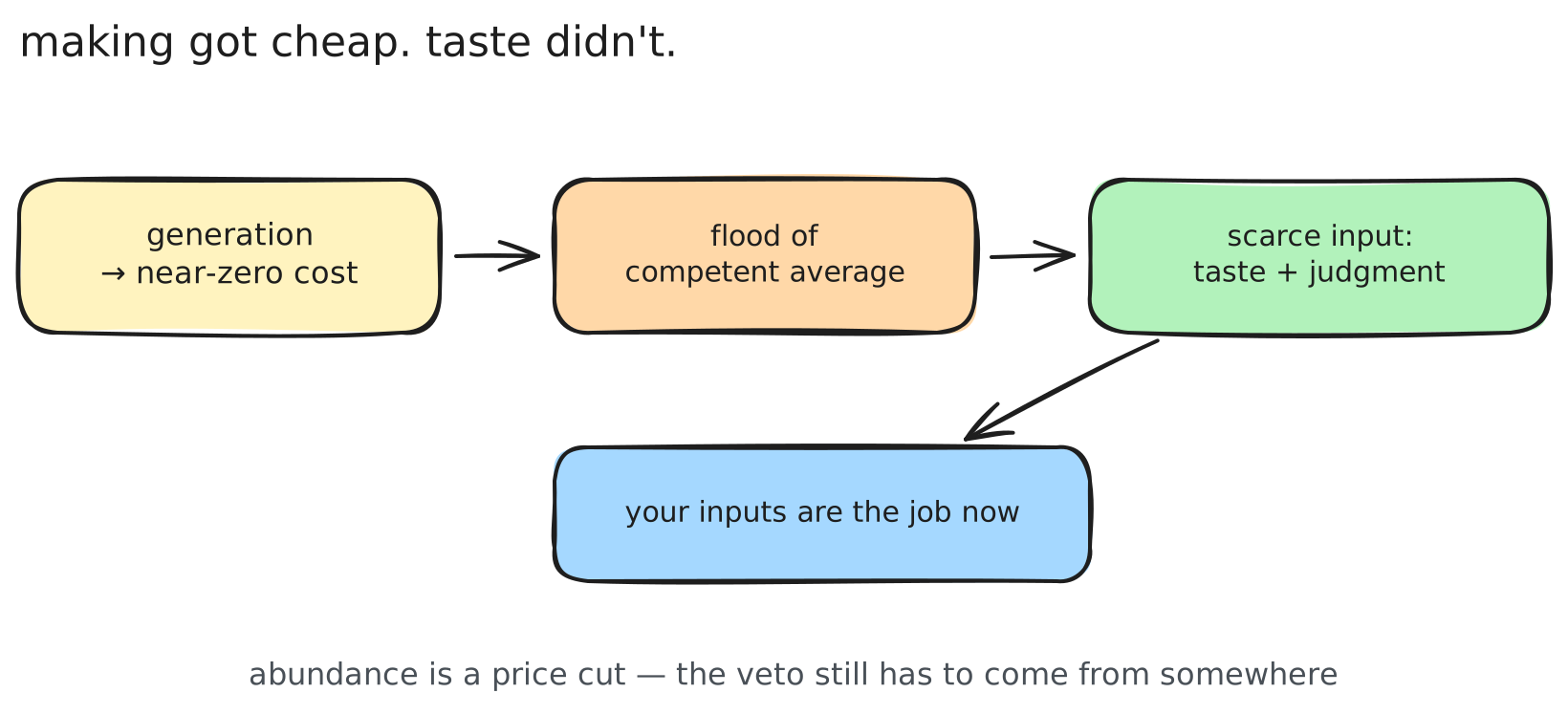
Here is the part people skip. When the supply of something explodes, its price collapses. That is not a metaphor, it is the first thing you learn in economics, and it is happening to software. The marginal cost of a working app is heading toward zero, so a working app is worth roughly that. Feature parity stops being a moat the moment a competitor can clone your feature set in a weekend.
And the demand side is hungrier in the press releases than in real life. Despite the "everyone uses AI for everything" story, only 34% of US adults have even tried ChatGPT, per Pew, and as Gabriel Weinberg argues from the data, people approach AI the way they approach meat: some adopt it fully, some ration it, some abstain. The real picture is a flood of cheap output arriving in front of a skeptical, selective audience. That does not lower the bar. It raises it.
The one input that doesn't commoditize
If execution is free and parity is worthless, what is scarce? Judgment. Knowing which problem is worth solving, and whether the thing you just made is any good. Call it taste.
A small, embarrassing example of my own. I built a calendar scheduling app. Why? Because I could, and I was curious about a new coding tool. cal.com already exists, is open source, and is free. My friends never used mine, not because it was broken, it worked fine, but because nothing had been engineered into it. cal.com has spent years on design, onboarding, distribution, and trust. That is not execution. Those are outcomes, and outcomes are where taste lives. I had confused finishing with making something worth using.
What taste actually is
Taste is not a vibe or a personal preference. Paul Graham argued this back in 2002: good design has properties you can name, like simplicity, solving the right problem, and durability, and taste is the trained ability to tell them apart. Mostly, taste is a no. It is knowing what to cut, what not to ship, and when something is not good enough yet. In a world drowning in "it works," the winners are the ones who make it secure, make it usable, make it trustworthy, make it with taste.
We ship faster than our taste can veto
The easy version of this argument is "most people just don't have taste." I don't think that's right. Ira Glass has a well-worn bit about the taste gap: you get into creative work because your taste already outruns your ability, and the gap between the two is the entire struggle. So it is not that we lack taste. It is that cheap execution now lets us ship faster than our taste can object. Shipping gives an instant hit. Sitting with "this isn't good yet" does not. We out-run our own judgment and call it productivity.
Your inputs are the job now
There is a deeper layer, and it is the one I keep coming back to. In the old world, your output was your contribution. Now the output is the model's. What is left that is yours is your judgment, and judgment is just your inputs, compounded. You are the average of what you consume.
Which is a problem, because the data on what we consume is grim. The average internet user now spends about 6 hours 38 minutes online every day, per DataReportal, and short-form video is the single most common thing they do with that time. In 2024, Oxford named its word of the year "brain rot": the deterioration of the mind from overconsuming trivial online content. We are not feeding our judgment. We are starving it on purpose.
Cheap inputs make cheap thoughts. The ceiling on what you can recognize as good is set by what you have exposed yourself to. So when the machine does the doing, consuming well stops being procrastination and becomes the actual work. It sits upstream of everything else.
What this means
Two honest caveats. Taste is not the only thing that matters, distribution is its sibling: taste earns you a product worth using, distribution gets it used, and you need both. And taste is built, not inherited, which is the optimistic part. It is trained sensitivity, fed by good inputs and reps with honest feedback.
But taste is the part the machine cannot hand you. When the cost of creation goes to zero, the value of judgment goes to infinity. Output is free now. Outcomes never were.