The Last Skill Is Knowing What You Want
There's a new genre flooding my feed since Claude Fable 5 shipped: the prompt pack. Eight copy-paste prompts that unlock the model. The definitive guide to effort levels. I've read a lot of them, and the good ones are genuinely good; the best taught me dials I use daily and I'll pass those along below. But after weeks of running Fable on real work, drafts, briefs, financial models, research, I've stopped believing the premise of the genre. The prompts work fine. They were just never the bottleneck.
Here is the moment that reframed it for me. When Anthropic launched Fable 5, a Stripe principal engineer reported that in their 50-million-line codebase it did in a day what would have taken his team more than two months by hand. Read that as an engineering story and it's easy to file away as someone else's news. But the same model, the same tier Anthropic calls Mythos-class, capable of weeks of autonomous work, is sitting in the model dropdown of every paid Claude plan. The two-months-in-a-day machine is pointed at your briefs, your decks, your campaign plans, your board updates.
And most of us are getting mediocre work out of it. Not because the model is overhyped, and not because we phrased the prompt wrong. Because of a gap the prompt packs never mention: the model can only build what you asked for, and most of us don't fully know what we want. Fable is the first model where that, not capability, is the limit. Engineers figured this out first. Thariq at Anthropic wrote a field guide about discovering his "unknowns" before Fable starts working, and it's excellent, and it's written for people who live in codebases. This is the version for the rest of us: founders, marketers, ops people, anyone whose work is briefs and decisions rather than pull requests.
Execution stopped being the hard part
Start with what actually changed, because the shift is measured, not vibes.
METR found that the length of tasks AI agents can complete autonomously has been doubling roughly every seven months for six years, and on the current trend they expect agents handling week-long tasks within a few years. Fable 5 is that trend shipping as a product: a 1-million-token context window, several long books' worth of your business in a single session, and a model that keeps notes to itself mid-task to stay coherent across a long run.
People are already delegating accordingly. Anthropic's own usage data shows full-delegation use of Claude jumped from 27% to 39% of conversations in under a year, and when businesses wire Claude in through the API, 77% of usage is automation: whole tasks handed over, not chat. And this stopped being a coders-only story a while ago. The latest edition shows office and administrative work, email, documents, scheduling, CRM, as one of the fastest-growing categories.
So the supply side is settled. Execution, the thing we all built careers on being fast at, is on a curve pointed at abundant and cheap.
The prompt was never the problem
Here's where I'll concede the obvious: the prompt-tips crowd saw part of this coming. IEEE Spectrum declared prompt engineering dead back in 2024 because models optimize their own prompts better than we do. The $200K prompt engineer job has evaporated. The engineers renamed the surviving skill: Tobi Lütke calls it context engineering, "the art of providing all the context for the task to be plausibly solvable," and Karpathy seconded it.
But notice what all of those answers have in common. They're input-side mechanics. They assume you already know what the task is. Context engineering tells you how to feed the model everything relevant to your goal. It has nothing to say about the harder, quieter problem of not actually knowing your goal.
And the evidence says that quieter problem is the one that decides outcomes. In the Harvard/BCG field experiment, 758 consultants used GPT-4 on realistic consulting tasks. Inside the set of tasks the AI was good at, quality rose 40%. On tasks just outside that set, AI users were 19 percentage points more likely to get the answer wrong than people working alone. Same model, same people, same prompting ability. The decisive variable was judgment about what to hand over and what to want from it. That was 2023-era AI; the models got better and the judgment gap got more expensive.
Meanwhile the depth gap is stark. Gallup finds 45% of US workers now use AI at work, but only 10% use it daily. McKinsey found nearly every company investing in AI while only 1% of leaders call their deployment mature, and concluded the barrier isn't the technology. The machine got a decade better in three years. We're the side of the equation that didn't move.
The gap has a name: your unknowns

The philosopher Alfred Korzybski gave us the phrase for this in 1931: the map is not the territory. Your brief is a map. The actual work, with its real constraints and your real preferences, is the territory. Everything your brief doesn't capture, every preference you didn't state, every constraint you forgot exists, is the difference between them. Thariq's word for that difference is unknowns, and when Fable hits one mid-task, it doesn't stop. It guesses. Multiply a thousand small guesses across a long autonomous run and you get work that is impressively complete and subtly not what you wanted.
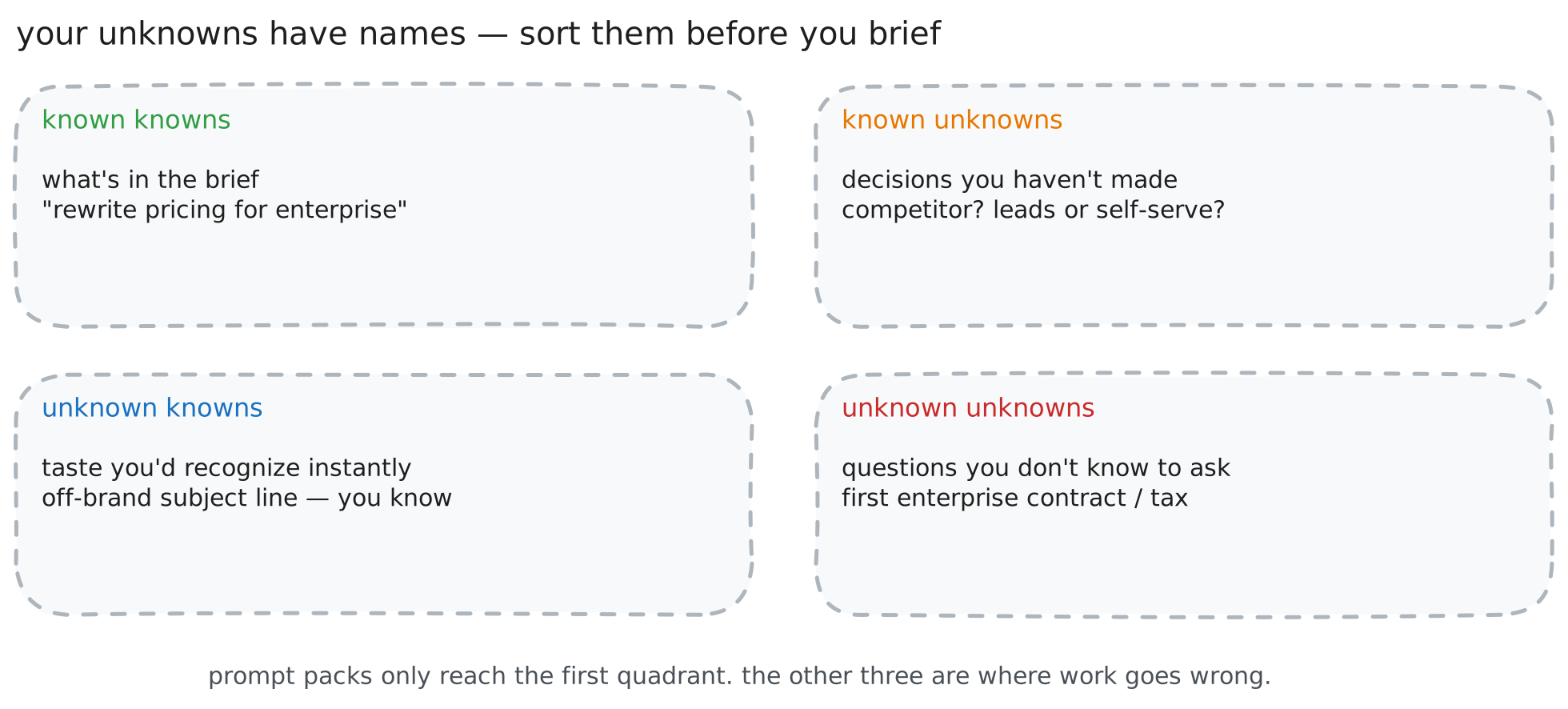
The useful move is sorting your unknowns, in the quadrant Donald Rumsfeld made famous (aerospace engineers were using it decades earlier). In operator terms:
Known knowns. What's actually in your brief. "Rewrite the pricing page for the enterprise tier." This is the only part the model receives.
Known unknowns. Decisions you know you haven't made. Which competitor are we positioning against? Is the goal leads or self-serve signups? You could answer these if asked. Nobody asked.
Unknown knowns. Taste you'd recognize instantly but have never written down. You know exactly why a subject line feels off-brand the moment you see it. That knowledge exists nowhere outside your head, so the model can't use it.
Unknown unknowns. The questions you don't know to ask. Every operator hits these the moment work crosses out of their lane: the founder writing her first enterprise contract, the marketer inheriting a rebrand, me the first time I touched anything tax-adjacent. You don't know what good looks like, so you can't even recognize a wrong guess.
The prompt packs address the first quadrant. The other three are where delegated work actually goes wrong, and no amount of prompt phrasing reaches them. What does reach them is using the model itself to interrogate you. That's the field guide.
The field guide: make the model interrogate you
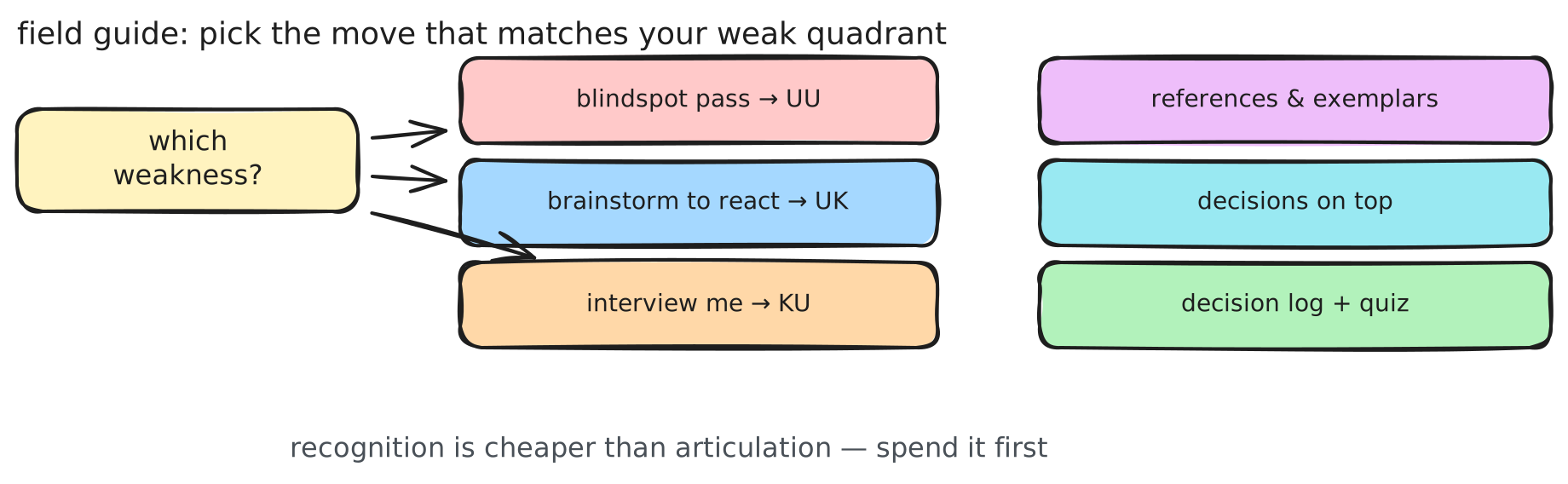
Six moves, roughly in the order of a real piece of work. I don't use all six every time. The skill is knowing which quadrant you're weakest in and reaching for the right one.
1. Run a blindspot pass before you brief. When the work is outside your lane, your problem is unknown unknowns, so make finding them the first task. Before briefing anything: "I need to plan our first paid acquisition campaign and I've never run paid. Before we do anything, do a blindspot pass: what are the questions I don't know to ask, what does good look like, and what do people usually get wrong? Then help me write a better brief." Five minutes of this routinely reshapes the entire project, because it fixes the brief before the brief starts compounding.
2. Brainstorm to react, not to choose. For unknown knowns, the taste you can't articulate, stop trying to describe what you want and put options in front of your own eyes. "Give me four genuinely different directions for this launch announcement: different tone, different structure, different lead. I'll tell you what I'm drawn to and what I'd never send." Your reaction to option three surfaces preferences you'd never have written in a spec. Recognition is cheaper than articulation. Spend it first.
3. Make it interview you. For known unknowns, invert the direction of questioning: "Before you write the plan, interview me one question at a time about anything ambiguous. Prioritize questions where my answer would change the whole approach." The ordering matters. A good interviewer asks about budget and audience before asking about fonts, and Fable, told to prioritize this way, is a genuinely good interviewer.
4. Hand it references, not adjectives. Some wants resist description entirely; every marketer who has typed "clean, modern, punchy" and gotten none of the three knows this. The fix is pointing at the real thing: "This newsletter is the voice I want. Here are three issues. Study what they do at the sentence level, tell me the pattern you see, then apply it to my draft." A reference carries a hundred decisions you'd never think to specify. Paste the artifact, not the adjective.
5. Ask for the plan with your decisions on top. Before letting Fable run long on anything, ask for a plan built for your review: "Draft the project plan, but lead with the decisions I'm most likely to want to change: anything customer-facing, anything spending money, anything hard to undo. Put the mechanical steps at the bottom." You're not reviewing the plan to check the model's work. You're reviewing it to find the wants you didn't know you had, while changing your mind still costs nothing.
6. Keep a decision log, then take the quiz. However well you briefed, a long run will hit unknowns anyway, so make the guesses visible: "Keep a running decisions file. Any time you hit something ambiguous, pick the conservative option and log it." That log is a map of exactly where your next brief needs to be sharper. And when the work comes back, borrow the engineers' best trick before you sign off: "Explain what you did and why, then quiz me on it. I want to be sure I understand this before I present it." If you can't pass a quiz on the work, you didn't delegate it. You abdicated it.
Know the dials, then get back to the wanting
The machine-specific stuff matters less than the genre suggests, but three dials are worth knowing. Fable has an effort setting, and in plain chat you control it with plain language: "quick pass, don't overthink this" versus "this is important, take your time and check your reasoning." Anthropic's own guidance is that teams get the best results pointing it at their hardest problems; testing it on small tasks undersells it, and for quick riffs a lighter model is faster and cheaper anyway. Tell it what done looks like, because a model built for long autonomous work will otherwise keep going past the point you wanted. And occasionally a safety classifier will route your request to Claude Opus 4.8 instead; more than 95% of sessions never see this, and when it happens the fix is usually adding context about why you're asking, not giving up.
That's the manual. Notice how short it is. Every dial above takes an afternoon to learn, which is exactly why none of them is a moat.
The trap: the better it gets, the less you want
Now the part where I turn this on myself, because there's a failure mode on the other side too, and I've felt it. The same model that can surface your unknowns can also quietly take over the wanting. A CHI 2025 study of knowledge workers found that the more people trusted the AI, the less critical thinking they did; the ones who kept their edge did it through goal-setting, briefing, and verification. One field experiment found signs that recruiters given better AI engaged less and missed more. The pattern is consistent: capability invites abdication.
So the honest version of this essay's advice has a discipline attached. Use every move above to let the model excavate what you want. Never let it decide what you want. The moment you catch yourself shipping option three because it was good enough rather than because you chose it, the bottleneck didn't get solved. It got abandoned.
None of this is a new prophecy, and I should say so. Kevin Kelly wrote in 2016 that "answers become cheap and questions become valuable", and Picasso beat him by five decades, saying of the new calculating machines in 1964: "But they are useless. They can only give you answers." What's new is that the prophecy came due, and it came due for everyone, not just the people who write code.
The wanting is the work now
I keep landing in the same place from different directions. Once anyone can generate anything, the output stops being the scarce thing. Fable 5 made that literal: execution, weeks of it at a time, is now something you rent by the token. The prompt packs will keep coming, and the models will keep improving, and both will keep compressing the value of everything downstream of a clear intention.
What they can't compress is the intention. Which segment, which trade-off, which version you'd actually put your name on: the model can help you find those answers faster than any tool ever built, and it still can't want them for you.
Execution became something you can rent. Wanting never will be. The last skill is knowing what you want, and it was always the first.