Agents Aren't the New SaaS. They're the New Agency.
There is a video going around titled AI Agents are the new SaaS, and it is good. Greg Isenberg lays out a clean, honest playbook: the product is the job, not the tool. Find a workflow with a paycheck attached. Shadow the human who does it before you build anything. Ship the smallest useful version. Wrap it so the customer can trust it. Sell the pilot like labor, then productize the parts that repeat. He is right about almost all of it, down to citing Anthropic's own advice to start with workflows and add autonomy only when it earns its keep. If you want a map for building an agent business this year, watch it twice.
I just think the title points at the wrong analogy, and the analogy is not a small thing. The pitch, agents are the new SaaS, imports a whole set of expectations about margins and scale and defensibility that the business underneath it does not actually have. Look closely at every step of that playbook and the same thing keeps happening. SaaS spent twenty years taking people out of the loop. The agent playbook puts them all back.
SaaS was a machine for removing people
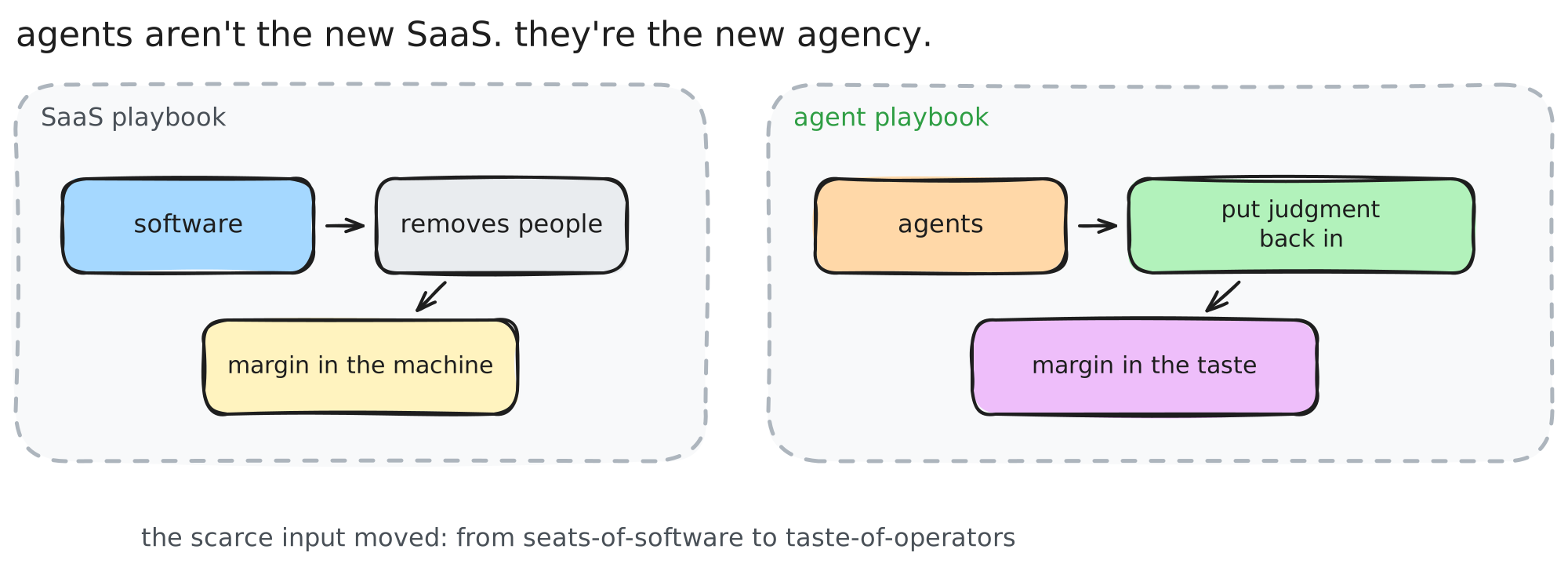
It is easy to forget what the "service" in software-as-a-service was reacting against. The generation before it sold you a tool and left you to get a result out of it, with a consultant on retainer to help you do it. SaaS collapsed that. The software was the deliverable. You signed up yourself, onboarded yourself, and got the outcome yourself, and the vendor's cost to serve one more account rounded to zero.
That is the entire reason SaaS is such a beautiful business. As a16z put it in its canonical breakdown of software economics, software "can be produced once and sold many times," which is how it earns "high (60-80%+) gross margins." David Sacks says it more bluntly: "all the major expense was in creating the first copy; subsequent copies were virtually free." And when a real services line sneaks into a SaaS company, you can watch it drag the average down. In Benchmarkit's 2025 data, subscription revenue carries an 81% gross margin. The professional-services revenue sitting right next to it carries 30%.
Near-zero marginal cost, no humans in the delivery loop, the product does the work: that is what "SaaS" actually names. Hold onto it, because the agent playbook violates every clause.
The agent playbook puts the people back
Walk the steps again and mark each one for what it really is.
Shadow the human and run the job manually with Claude before you build. That is a16z's forward-deployed services motion, doing the work by hand to learn it. Build a fifty-example eval set for each client. That is a bespoke, per-account artifact, made by a person, worthless the day the client leaves. Wrap the agent in a control room with logs and approvals and escalation to a human when the case gets weird. That is a human, back in the loop, by design. Sell three clients in one niche with a setup fee and a monthly retainer. That is an agency's cover sheet.
Isenberg is admirably direct about it. His own line is that "the wrapper is the SaaS." But the wrapper he describes is a dashboard a human watches so they can catch the agent before it fails a customer. That is not software replacing labor. It is software supervising it, which still needs the labor.
The margins tell on the whole arrangement. a16z found AI companies running gross margins "often in the 50-60% range, well below the 60-80%+ benchmark for comparable SaaS businesses," dragged down by inference cost and by the human-in-the-loop work that can eat "10-15% of revenue." Their verdict on the category is the one word the "new SaaS" pitch skips over: these companies "combine elements of both software and services." Not software. Both.
This has a name, and it isn't SaaS
The people paying closest attention already named it, and they did not call it SaaS. Two years ago Sarah Tavel at Benchmark told founders to sell work, not software: "rather than sell software to improve an end-user's productivity, consider what it would look like to sell the work itself." Sequoia calls the resulting company a "software company masquerading as a services firm" and points out that "for every dollar spent on software, six are spent on services." Foundation Capital gave it the tidy, honest name, service-as-software, and drew the line the "new SaaS" framing blurs: in software, "customers are still responsible for using that tool to achieve the desired outcome"; in services, "responsibility for achieving the desired outcome sits with the company selling the service." An agent that books the job owns the outcome. By their own definition, that makes it a services business.
Tomasz Tunguz has the cleanest one-liner for the shape of it: "SaaS unbundled, AI rebundled." The SaaS era, he writes, was "defined by unbundling: find a workflow, optimize it, own it." The agent era runs the tape backward, gluing the workflow, the judgment, and the accountability back into one thing you buy. And what you are buying is not features. "They're selling trust." Jim Barksdale said there were only ever two ways to make money, bundling and unbundling. SaaS was the unbundling. This is the rebundling, and rebundled work is just an agency with better tooling.
The reversal is the good news
Here is the part that makes the mislabeling worth correcting instead of just pedantic: being an agency instead of SaaS is the bull case, not the bear case.
Isenberg's strongest point is that the market is bigger, and he is right, for a reason the "new SaaS" framing actually undersells. a16z's Alex Rampell puts it plainly: the enterprise software market, "which looks big at $300B/year in spend, is infinitesimal compared to the white-collar labor market, at many, many trillions of dollars a year." Companies spend orders of magnitude more on people than on software. But that labor budget is not sitting around unclaimed. It is enormous precisely because it is the work software could never absorb: the judgment, the follow-through, the being-accountable-for-a-result that never fit inside a tool. You get to sell into a multi-trillion-dollar market on the exact condition that the work resists becoming clean, self-serve software. The moment it fully productizes, it stops being labor and collapses to software prices.
Which is why the winners already price like labor, not like software. Sierra, Bret Taylor's company, does not charge per seat. It charges per resolved outcome and nothing when it escalates to a human, and Taylor's framing is the whole thesis in a sentence: "the atomic unit of productivity in AI is a process, not a person." a16z watched the same shift and concluded that "per-seat is no longer the atomic unit of software": once the agent does the work, there are fewer humans to buy seats for, so you have to bill for the work instead. Intercom charges 99 cents a resolution. Salesforce charges two dollars. Per-outcome pricing is not a clever monetization tactic. It is what selling labor looks like on an invoice.
The honest objection: doesn't the human just shrink away?
The strongest counter is that all of this is temporary. The services layer is scaffolding, the argument goes, and as the models improve it falls away until what is left is real, high-margin, self-serve SaaS after all. Bessemer makes the most data-backed version: it predicts vertical AI will be worth at least 10x legacy vertical SaaS, points to LLM-native companies "growing ~400% year-over-year while still maintaining a healthy ~65% gross margin," and notes they already reach "80% of the ACV" of the incumbents. Garry Tan says the 300 vertical AI unicorns are coming, and bigger than the SaaS ones, because "they replace the operators too." a16z's own thesis is that you run the manual motion now and the "high margins that eventually follow." It is a serious case, and I think it is partly right.
But notice what it concedes. Bessemer's own number is 65% gross margin, closer to a services business than to the 80-90% of mature SaaS, and its own framing is that these companies are competing for labor budgets. Tan's unicorns win by replacing operators, which is the agency's job, done with domain expertise and change management, not a self-serve signup. The productization is real, and for some narrow workflows it will go all the way. Those are exactly the ones that will earn software margins and, right on cue, software-sized prices, because a job a machine can do unsupervised is a job nobody pays a premium for. The valuable remainder is the opposite: the work where the eval set, the exception handling, and the human who owns the mistake never fully leave. Cheaper inference does not rescue you there. Per-token cost keeps falling, but as one analysis of AI margins notes, "the meter runs faster" as usage grows, and the judgment layer does not fall to zero. It moves to the hardest, best-paid edge. Gartner expects more than 40% of agentic AI projects to be cancelled by 2027, and the ones that die are the ones that believed the human was optional.
This is where I landed a level down. Last year the argument was that the harness commoditizes, and what compounds is your encoded judgment and your client relationship. This is the same claim one story up the building. It is not just that boring agents beat flashy ones. It is that the whole category is an agency wearing a SaaS costume, and the costume is the cheapest thing in the outfit.
Call it what it is
So call it what it is. Not because "agency" is the lesser word, but because the label decides what you think you own. The SaaS label tells you the software is the asset and the services are friction to engineer away. The services-as-software label tells you the truth: the software is the cheap, copyable part, and the asset is the judgment and the trust that never compiled into it.
SaaS got rich selling the work and keeping the workers out of it. The agent business gets rich selling the workers back, one finished job at a time. That is not the new SaaS. It is the oldest business there is, finally priced like software.