The Workspace Was Never the Moat
Paying your single biggest AI rival to live inside your own product sounds like a strategy meeting that went badly wrong. It isn't. It is close to the most rational thing Salesforce has done all year, and that is exactly what should worry it.
The math makes it rational
Salesforce is doing three things to Anthropic at once. It expects to spend about $300 million on Anthropic tokens this year, most of it on coding. It holds a stake in Anthropic that Bloomberg now values around $5 billion, built from a roughly $50 million bet in 2023, so call it a hundred-fold paper return. And it just gave Anthropic's newest agent, Claude Tag, prime placement inside Slack, the workspace Salesforce owns.
Line up the numbers and the behavior stops looking insane. Anthropic is worth $965 billion after its Series H and filed confidentially to go public on June 1. Salesforce is not just a customer of its rival. It is an investor about to get liquid. Boosting Claude protects a position worth several times the $1.2 billion in Agentforce ARR that Claude quietly competes with. When your rival is also your best-performing investment, promoting it is just good portfolio management.
That is the tell, not the contradiction. Salesforce has read the situation correctly. The question is what the situation is.
Three agents, one login
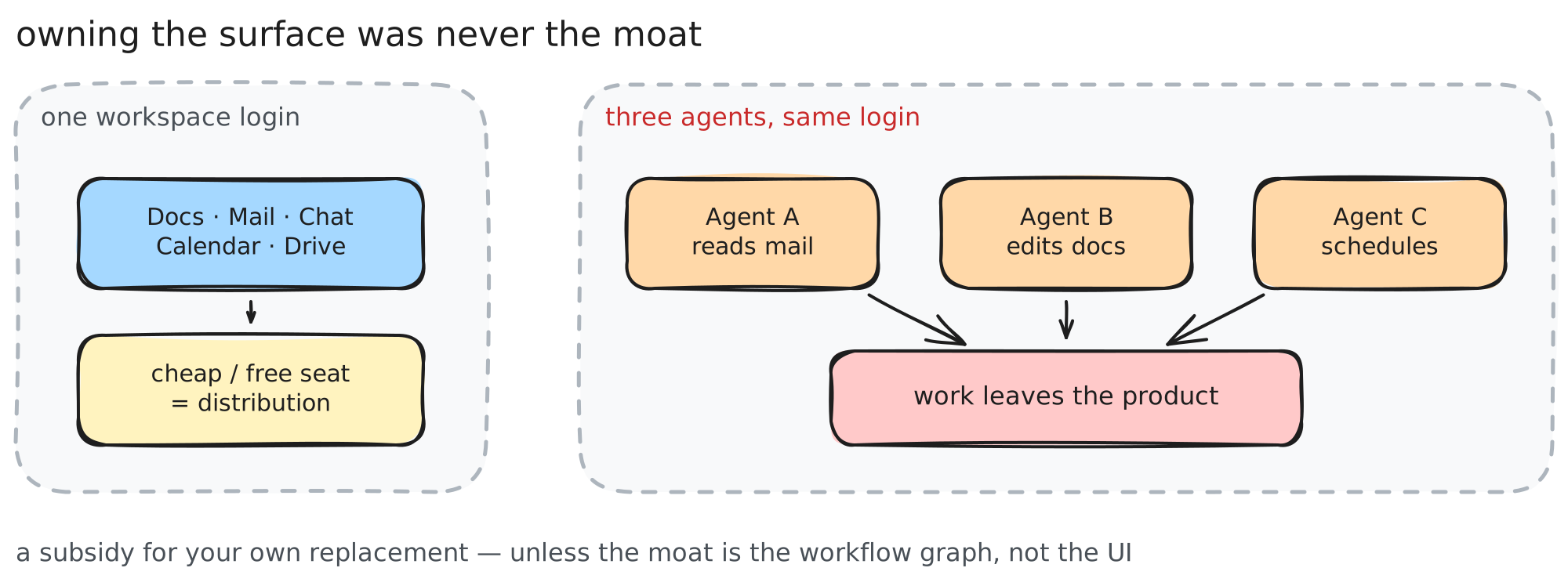
Open Slack today at an enterprise that has bought in, and you can hand the same task to three different agents. Slackbot, which Salesforce gave more than thirty agentic capabilities in March. Agentforce, its flagship. And now Claude Tag, which since June 23 lets anyone type @Claude in a channel, follows along in an ambient mode, and, the part that matters, learns your company over time instead of starting fresh every session.
Three agents, one workspace, heavy overlap. Even the people closest to Salesforce are puzzled. A member of its own advisory board said he was "genuinely excited and confused" about how Claude Tag fits together with Slackbot. Rippling's CEO called it a real misstep. Salesforce Ben ran the honest headline: what is Agentforce for?
Three competing agents stapled into one workspace is not a platform strategy. It is a turf war with a shared Slack login.
The generous reading, and why it is not enough
There is a smart defense of all this, and it deserves a fair hearing. Vernon Keenan calls it co-opetition: deliberate, not confused. No AI vendor has won yet, so Salesforce refuses to bet on one. Anthropic is the first model provider fully inside the Salesforce trust boundary, all of Claude's traffic contained in Salesforce's own cloud, data never used for training, Claude wired to call Agentforce to actually execute. The logic: if you cannot stop the agent wave, make sure that whatever wins, wins on your surface, with your data, under your governance.
It is coherent. The governance point is real, and it is the strongest card Salesforce holds. But governance is not the same thing as a moat, and this is where the strategy quietly inverts.
Owning the surface was never the moat
Ben Thompson's Aggregation Theory has been the operating manual of the internet era for a decade: value flows to whoever owns the user relationship, not to whoever owns the pipes or the shelf space. Suppliers get commoditized. Aggregators win.
Watch what that does to the parallel everyone reaches for. Google pays Apple around $20 billion a year to be the default search engine in Safari. But Google owns the demand. It is renting a slot on someone else's glass to keep rivals off it. Salesforce has run the same play in reverse. It is paying to host, inside its own product, the thing users are starting to form the relationship with. Every time someone types @Claude instead of @Agentforce, the habit, and the accumulated memory of how that company works, builds up on Anthropic's side of the line, not Salesforce's.
That is the move I keep watching repeat. Last year the harness commoditized: the framework you run an agent on stopped being worth building yourself. This is the same thing one level up. Satya Nadella put it plainly, the application layer collapses into agents, and Bain sized the shift, routine work moving from human-plus-app to agent-plus-API. The workspace is becoming what the harness became: supply. The agent is the aggregator now.
A subsidy for your own replacement
The honest complication is that memory cuts both ways. Anthropic's own push toward open, portable skills means the institutional knowledge an agent builds up is not permanently locked to any one platform. But portability does not rescue Salesforce. It helps whoever runs the operator layer the user actually talks to, and right now Salesforce is paying to make that Anthropic.
Anthropic has been open about where this goes. Claude Tag started in Slack, and Anthropic says it wants @Claude in the many other places teams work. The day Claude no longer needs Slack to reach those users, the $300 million and the trust boundary stop being leverage and start being a subsidy for your own replacement. Salesforce is renting out the one surface it fully controls to the company most likely to make that surface optional.
The alternative is not picking a side
The reflex is to ask which of the three agents wins. Wrong question. The answer is not Slackbot or Agentforce or Claude. It is not needing three agents elbowing each other for attention in the first place. One operator, many models, routing each task to whichever model is actually best, owning the context and the governance on your side of the line rather than the vendor's. The multi-model orchestration layer is where this is heading regardless of who wins the model race.
The company that owns the operator owns the work, and no amount of owning the room changes that.
Owning the surface means owning where the work happens. Owning the agent means owning the work itself. Salesforce is paying its biggest rival to keep the first and hand over the second.